

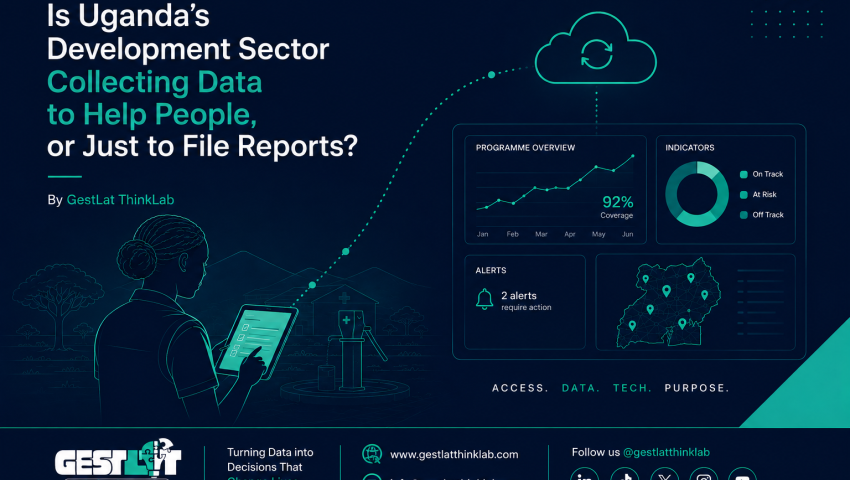
A thought leadership article on sythensizing Uganda's development sector report-driven M&E to real-time MEAL, questioning wheather Uganda's Development Sector Collecting Data to Help People, or Just to File Reports?
This is the quiet inefficiency at the heart of a great deal of development work in Uganda — and it is not for lack of data. Even after a sharp contraction, the country still hosts thousands of non-governmental organisations: the National Bureau for NGOs counted over 14,000 registered organisations in 2019, a figure that had fallen to roughly 6,000 by 2024 as foreign aid tightened, according to discussions at the Foundation for Human Rights Initiative. With more than 98% of Ugandan NGOs reliant on foreign donations, the sector runs on the relentless measurement that donors require: baselines, midlines, endlines, indicators, logframes. Few sectors collect more data per shilling spent. The problem is what happens to it.
WHEN DATA ARRIVES TOO LATE TO MATTER
IT IS NO LONGER JUST ABOUT DIGITAL FORMS
Many organisations have already replaced paper questionnaires with digital forms. That is an important first step, but digitising paper alone does not transform decision-making. A PDF generated from a mobile phone is still just another report if no one can act on the information in time.
Modern data ecosystems connect field data to live dashboards, maps, automated quality checks, and operational alerts. Instead of waiting for quarterly reviews, supervisors can identify implementation challenges as they emerge and intervene while projects are still underway.
The real innovation is not digital data collection—it is shortening the distance between observation and action.
Traditional monitoring and evaluation was built around the report, not the response. Data is gathered in the field, carried or keyed back to a centre, cleaned, and turned into a document that lands long after the moment it described. The model treats measurement as accountability to a funder rather than as a tool for the implementer — a backward-looking audit instead of a live instrument. The result is a sector that knows, in great detail, what went wrong six months ago, and very little about what is going wrong today.
The waste is the same one that quietly afflicts data everywhere. Across organisations globally, the analytics firm Splunk found that 60% of respondents say half or more of their data goes unused, and a full third say 75% or more sits idle; Seagate’s Rethink Data study put the share of enterprise data actually “put to work” at just 32%. Development data is no exception — much of it is collected once, filed, and never looked at again. A nutrition programme that learns of stockouts a quarter late has already failed the children it missed. A livelihoods project that discovers low attendance after the fact has already spent the money. And because the data exists only to satisfy the report, it is rarely designed to be reused — every project builds its own forms, its own indicators, its own standalone system that dies when the funding ends, taking its lessons with it.
THE FEEDBACK LOOP THAT IS USUALLY MISSING
DATA SHOULD MOVE AS FAST AS THE PROBLEMS IT DESCRIBES
Imagine a nutrition programme operating across twenty health facilities. Under traditional monitoring, stock shortages may only become visible in a quarterly report. In a real-time environment, those shortages trigger alerts immediately, allowing supplies to be redistributed before children are turned away.
The same data is collected, but its value changes entirely because it arrives while action is still possible.
There is also a moral dimension the sector rarely names. Data is extracted from communities — their time, their answers, their trust — and flows upward to the funder, but the loop almost never closes back to them. The household that answered forty questions seldom learns what the project found or how it changed anything. Measurement that only ever reports upward, never downward, is not really accountability to beneficiaries at all. It is accountability about them.
The timing matters more now than ever. The abrupt suspension of major donor programmes — the freezing of USAID activity chief among them, in a country where the US channelled most of its assistance through local NGOs — has left organisations under intense pressure to prove impact and efficiency to a shrinking pool of funders. In that climate, data that cannot demonstrate live results, only past compliance, is a liability the sector can no longer afford.
WHAT REAL-TIME MEASUREMENT CHANGES
FROM REPORTING TO DECISION INTELLIGENCE
Development organisations increasingly operate in rapidly changing environments. Modern MEAL systems should function as operational control centres that answer practical questions in real time: Where are programmes falling behind? Which indicators are deteriorating? Which teams need support today?
The fix is not more data; it is faster, connected, usable data. When field teams collect on mobile devices that sync the moment there is a signal — and store safely offline until there is — a manager can see a stockout the day it happens, not the quarter it ends. Dashboards can flag the training with collapsing attendance while there is still time to act. Standardised, interoperable data means a finding from one project can inform the next instead of dying with it. None of this is exotic; the tools exist, are increasingly affordable, and run on the same phones field officers already carry. Open-source platforms have made mobile, offline-first data collection the global norm for serious field operations.
The shift is as much mindset as technology. It means treating measurement as a steering wheel rather than a rear-view mirror — something that guides the project while it runs, not something that grades it after it ends. It means designing data systems for the implementer and the community first, and the donor report as a by-product rather than the purpose. Funders, increasingly, are asking for exactly this: evidence of adaptation, not just compliance.
BUILDING SYSTEMS THAT OUTLIVE PROJECTS
Too many information systems disappear with the grants that funded them. Organisations should build interoperable platforms using open standards and APIs so knowledge survives beyond individual projects and strengthens future programmes.
THE NEXT FRONTIER: AI AS A DECISION SUPPORT TOOL
AI can help detect unusual reporting patterns, summarise field observations, predict implementation risks, and prioritise management attention. Its purpose is to augment human judgement, not replace it.
TECHNOLOGY ALONE IS NOT THE ANSWER
Technology succeeds only when organisations build routines around using data. Dashboards should drive weekly decisions, not simply decorate reports.
Build Digital-First Field Operations
Replace paper workflows with offline-capable mobile data collection.
Prioritise Live Operational Visibility
Use dashboards to guide operational decisions before reporting cycles.
Design for Interoperability
Adopt common standards so knowledge outlives individual grants.
Close the Feedback Loop
Return findings to communities and strengthen accountability.
Treat Data as Strategic Infrastructure
Invest in governance, quality, cybersecurity, and analytical capability.
Development organisations in Uganda should move deliberately from periodic, paper-bound M&E toward real-time, mobile-first systems that work offline and surface results as they happen. They should adopt common data standards so evidence outlives any single grant. They should build feedback loops that return findings to the communities who supplied them. And they should invest in the unglamorous backbone — clean data, trained field teams, dashboards people actually use — that turns measurement into management.
The sector does not have a data problem. It has a timing problem and a purpose problem: too much of what it collects arrives too late and serves the wrong audience. Fix that, and the same questionnaires that now fill reports could instead fix the borehole before the season turns. The real test of monitoring is not whether it produced a tidy report at the end — it is whether anyone was better off because of what it found along the way.
The future of monitoring is not measuring yesterday. It is helping organisations make better decisions today.
At GestLat ThinkLab, our Realtime MEAL service helps development organisations turn field data into live, offline-capable dashboards that inform decisions while there is still time to act. Access. Data. Tech. Purpose.

Author
GestLat ThinkLab
Leave a comment
Your email address will not be published. Required fields are marked *