

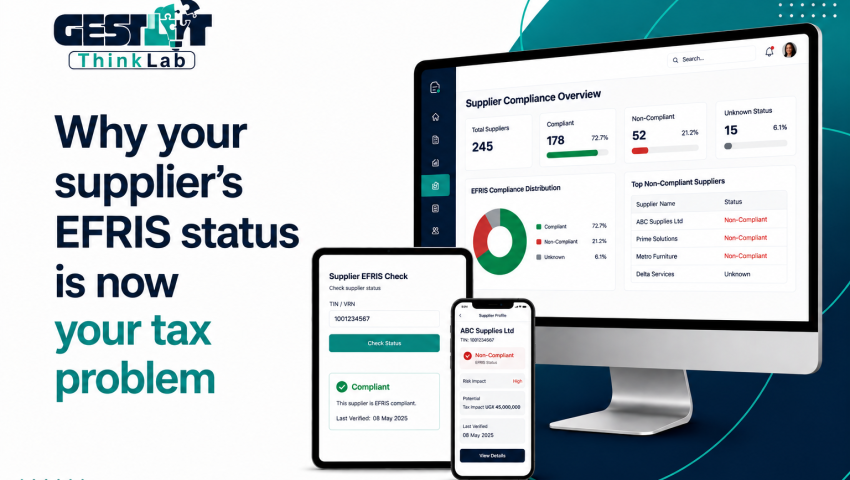
Since July 2025, EFRIS applies to twelve entire sectors regardless of VAT registration. If a supplier does not issue you a compliant e-invoice or e-receipt, you lose the deduction and the input VAT credit. What that costs, and how to control it.
The invoice that costs you twice
A finance manager closes the year, files the return, and hears nothing for eight months. Then the assessment arrives. A supplier — a transport firm, a printer, an IT contractor — has been invoicing on a letterheaded PDF all year, the way it always has. Every one of those payments is now a disallowed expense.
The company did nothing wrong. It bought real services from a real supplier at a fair price, paid by bank transfer, and filed every document. It still owes the tax.
This is the part of Uganda's e-invoicing regime that catches businesses out. EFRIS is usually explained as an obligation you have as a seller. Since July 2025 it is also, and more expensively, an exposure you carry as a buyer.
Your supplier's compliance is no longer their problem to manage. It is a line item in your tax return.
What changed in July 2025
The Uganda Revenue Authority issued General Notice No. 2218 of 2025 on 25 July 2025, applying retrospectively from 1 July 2025 (SM&Co. Advocates, 2025). It extended mandatory EFRIS use to twelve entire sectors of the economy.
The significant word is entire. Before the notice, EFRIS obligations broadly tracked VAT registration: if a supplier was below the UGX 150 million VAT threshold, the question of e-invoices largely did not arise. After it, every business operating in a designated sector must issue EFRIS documents regardless of whether it is registered for VAT (CEO East Africa, 2025).
The twelve designated sectors
| Sector | Who this catches in practice |
|---|---|
| Wholesale and retail of fuel | Fuel cards, bulk diesel for generators |
| Mining and quarrying | Aggregate, murram, stone suppliers |
| Manufacturing | Any producer you buy inputs or packaging from |
| Electricity, gas, steam and air conditioning | Power supply, HVAC contractors |
| Water supply, sewerage and waste management | Water, waste collection, sanitation services |
| Construction | Fit-outs, civil works, maintenance contractors |
| Transportation and storage | Logistics, courier, warehousing, distribution |
| Accommodation and food service | Hotels, conference venues, catering, staff meals |
| Information, technology and communication | Software vendors, ISPs, hosting, telecoms |
| Real estate | Landlords, agents, property management |
| Professional, scientific and technical | Auditors, lawyers, consultants, engineers |
| Arts, entertainment and recreation | Event production, venue hire, sponsorship |
Read that list as a buyer rather than a seller and the scope becomes clear. Rent. Internet. The audit. Legal advice. The annual staff retreat. Transport. Almost every organisation in Uganda buys from at least four of these sectors every month.
Why the buyer carries the cost
The legal framework for EFRIS sits in Section 73A of the Tax Procedures Code Act 2014, which allows the Commissioner to designate which taxpayers must issue e-invoices or e-receipts, or use an electronic fiscal device linked to URA's central system (Uganda Revenue Authority, 2026).
Two documents exist under that framework, and the distinction matters when you are chasing a supplier:
- An e-invoice is issued by a supplier who is registered for VAT.
- An e-receipt is issued by a supplier who is not registered for VAT (Uganda Revenue Authority, 2026).
A supplier telling you they are "too small for EFRIS" is describing the position before July 2025. If they operate in a designated sector, they owe you an e-receipt whether or not they charge VAT.
The consequence for you flows from a rule that has been in force since 1 January 2021: expenses falling under EFRIS are deductible only where they are supported by an e-invoice or e-receipt (RSM Uganda, 2021). Pair a long-standing deduction rule with a sharply widened set of covered suppliers, and a compliance obligation that used to belong to large VAT-registered vendors becomes an exposure sitting inside your own accounts payable ledger.
What it actually costs
The exposure has two limbs, and whether you suffer one or both depends on your supplier's VAT status.
Take a year of purchases from a single non-compliant supplier: UGX 50,000,000 net of tax. Uganda's corporate income tax rate is 30% for resident companies, and VAT is 18% (PwC, 2026).
| Case A: VAT-registered supplier, no e-invoice | Case B: non-VAT supplier in a designated sector, no e-receipt | |
|---|---|---|
| Net purchase | UGX 50,000,000 | UGX 50,000,000 |
| VAT charged at 18% | UGX 9,000,000 | — |
| Total paid | UGX 59,000,000 | UGX 50,000,000 |
| Input VAT credit lost | UGX 9,000,000 | — |
| Deduction disallowed | UGX 50,000,000 | UGX 50,000,000 |
| Additional income tax at 30% | UGX 15,000,000 | UGX 15,000,000 |
| Total exposure | UGX 24,000,000 | UGX 15,000,000 |
| As a share of the net purchase | 48% | 30% |
In Case A you paid UGX 59,000,000 and the arrangement cost you a further UGX 24,000,000 — nearly half the value of what you bought, on top of what you bought it for. No penalty has been applied at this stage and nobody has accused you of anything. This is simply the arithmetic of an expense you cannot deduct and VAT you cannot recover.
Two further points sharpen it. Input VAT must be claimed within six months of the invoice date (Grant Thornton, 2026), so a supplier who promises to "sort out the paperwork later" may be promising something that has already expired. And separately from your own position, the supplier faces a penalty of twice the tax due on goods or services invoiced outside EFRIS, up from the previous penalty of the tax due on those goods or services, or UGX 6 million (Ernst & Young, 2025).
This is now a procurement question, not an accounting one
The uncomfortable feature of this regime is that the loss lands on the party with the least control. Your accounts team can only work with the documents suppliers send. By the time a missing e-invoice surfaces in a year-end review, the money is spent, the service is consumed, and the supplier has no commercial reason to help you.
Which moves the control point upstream, to the moment you choose a supplier and agree terms.
Confirm the sector, not the size
Ask whether the supplier operates in a designated sector. Their turnover and VAT status no longer settle the question.
Ask for a sample document
A compliant document carries a Fiscal Document Number, the device number, and both parties' TINs. Ask to see one before you contract.
Put it in the contract
Make a valid e-invoice or e-receipt a condition of payment, so the obligation is enforceable rather than a favour.
Reconcile monthly, not annually
Input VAT expires six months after the invoice date. A year-end check finds problems that can no longer be fixed.
What it means for the systems you buy
There is a second-order effect worth naming, because it changes what "good" looks like in a business system.
If you sell in one of the twelve sectors, your customers now have a direct financial interest in your compliance. A hotel that cannot issue an e-invoice is asking a corporate client to absorb 30% of the conference bill in lost deductions. A manufacturer invoicing outside EFRIS is handing its distributors the same problem. Suppliers who cannot produce compliant documents do not merely risk a penalty — they become more expensive to buy from than a compliant competitor, by an amount their customer can calculate exactly.
That makes EFRIS capability a procurement criterion for point-of-sale, ERP, hospitality and property systems rather than an optional module. A system that records a sale but cannot fiscalise it leaves the business doing the work twice, and a system that fiscalises only some transaction types leaves gaps that surface at audit.
Gestlat ThinkLab operates in the ICT sector, which is itself one of the twelve. We had to answer these questions for our own invoicing before we could answer them for anyone else's.
Where to start
If you do nothing else this quarter, run the twelve sectors against your supplier list and identify who you are exposed to. It is usually a shorter list than people expect, concentrated in rent, transport, professional fees and connectivity — and it is far cheaper to fix in a supplier conversation than in an assessment.
This article explains a general position and is not tax advice. Tax rules change, and the Income Tax (Amendment) 2026 took effect on 1 July 2026 with URA implementation guidance still being issued at the time of writing. Confirm your own position with URA or a qualified tax adviser before acting.
Figures current as at 10 August 2026: corporate income tax 30%, VAT 18%.
References
- CEO East Africa. (2025). URA expands EFRIS compliance to 12 new sectors in sweeping tax digitisation move.
- Ernst & Young. (2025). Uganda issues Tax Amendment Acts for 2025. EY Global Tax Alerts.
- Grant Thornton. (2026). Indirect tax — Uganda.
- PwC. (2026). Uganda — Corporate: Taxes on corporate income. Worldwide Tax Summaries.
- RSM Uganda. (2021). The new Electronic Fiscal Receipting and Invoicing System in Uganda.
- SM&Co. Advocates. (2025). EFRIS expansion to new business sectors: What taxpayers need to know.
- Uganda Revenue Authority. (2026). EFRIS.

Author