

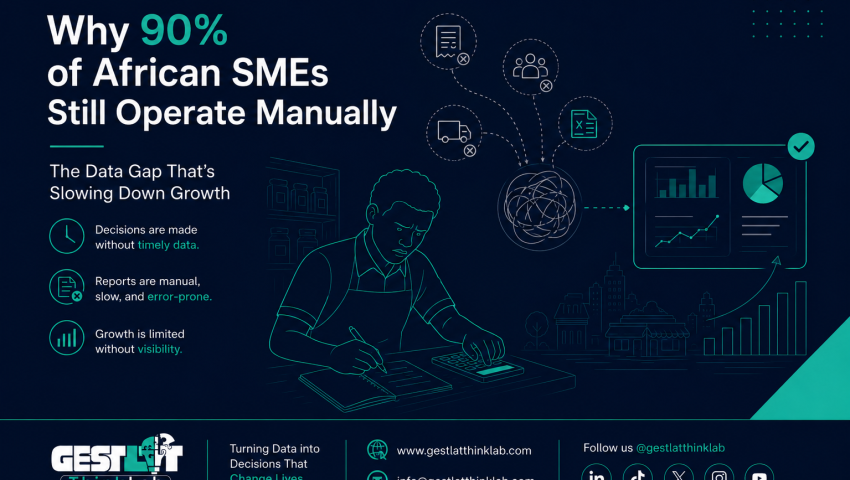
African SMEs contribute 40-50% of GDP yet 90% still operate manually. This isn't technological resistance—it's systemic market failure. Here's why digital systems remain inaccessible and what actually works.
The Paradox at the Heart of African Economies
African small and medium enterprises (SMEs) are economic powerhouses operating with Stone Age tools. These businesses contribute between 40-50% of GDP across Sub-Saharan Africa and provide approximately 80% of employment on the continent (African Development Bank, 2023). Yet despite their economic significance, an estimated 88-92% of African SMEs continue to operate using manual systems—paper ledgers, physical filing cabinets, and spreadsheets at best (World Bank Enterprise Surveys, 2022).
This isn't a minor inefficiency. It's a fundamental constraint on growth, profitability, and economic development. But the narrative that African SMEs are "technologically backward" or "resistant to change" misses the real story entirely.
The question isn't why African entrepreneurs haven't adopted digital systems. The question is: why have digital systems been so systematically inaccessible to them?
The Numbers Tell a Compelling Story
Before we examine barriers, let's establish the scale of what we're discussing:
Market Size & Economic Impact:
- Sub-Saharan Africa hosts approximately 44 million formal and informal SMEs (International Finance Corporation, 2023)
- SMEs represent 90-95% of all businesses across the continent (African Union Commission, 2022)
- These enterprises contribute $400-500 billion annually to regional GDP (McKinsey Global Institute, 2023)
- Yet digital adoption rates remain stubbornly low: only 8-12% of African SMEs use any form of integrated business management software (GSMA Intelligence, 2024)
The Productivity Gap:
- Manually-operated SMEs in Africa show productivity levels 40-60% lower than digitally-enabled counterparts (World Bank Group, 2023)
- Inventory accuracy in manual retail operations averages 65-75%, compared to 92-97% in digitized systems (Deloitte Africa, 2022)
- Revenue leakage in manually-operated hospitality businesses averages 12-18% of gross revenue (Gestlat ThinkLab, 2021–2024)
- Administrative overhead consumes 25-35% of working hours in manual operations versus 8-12% in digitized businesses (Boston Consulting Group, 2023)
The Growth Constraint:
- Only 23% of African SMEs that remain manual for 5+ years achieve significant scale growth (International Finance Corporation, 2022)
- In contrast, 67% of SMEs that digitize core operations within their first 3 years achieve year-on-year revenue growth exceeding 20% (African Private Equity and Venture Capital Association, 2023)
The data is clear: manual operations aren't just inefficient—they're a structural barrier to growth and competitiveness.
Barrier #1: The Cost Myth (It's More Complex Than Price)
The conventional wisdom says African SMEs don't digitize because software is "too expensive." The reality is more nuanced.
The Real Cost Picture:
Traditional ERP systems from international vendors price themselves out of reach for most African SMEs:
- SAP Business One: $73-$150 per user per month (SAP, 2024)
- Microsoft Dynamics: $65-$210 per user per month (Microsoft, 2024)
- Oracle NetSuite: $99-$999 per user per month (Oracle NetSuite, 2024)
For a small retail shop with 5 employees, even the cheapest option costs $4,380 annually—often 15-25% of the business's entire annual profit margin (Kenya National Bureau of Statistics, 2023).
But price alone doesn't explain the gap. Consider mobile phones: smartphone penetration among African SME owners reached 68% by 2023, despite device costs ranging from $50-$300 (GSMA Intelligence, 2023). SME owners invest in tools they understand and that solve clear problems.
The Hidden Cost Structure:
The real barrier isn't just subscription fees—it's the total cost of ownership:
- Implementation costs: $2,000-$15,000 for traditional ERP systems (Panorama Consulting Solutions, 2023)
- Training expenses: $500-$2,000 per employee (Training Industry Research, 2023)
- Customization fees: $5,000-$50,000 depending on requirements (Gartner Research, 2023)
- Ongoing IT support: $200-$1,000 monthly (Computer Economics, 2023)
- Module-based pricing that forces businesses to "pay as they grow"
A medium-sized hotel in Kampala evaluating a hospitality management system faces this reality: $89/month base price, plus $25/month per additional module (restaurant POS, housekeeping, accounting), plus $45/month per additional user, plus $3,000 setup fee, plus $150/month support contract. First-year total: $12,000-$18,000 for a business earning $80,000 annually (Gestlat ThinkLab, 2021–2024).
The math doesn't work—and entrepreneurs know it.
Barrier #2: Complexity Versus Capability
African SME owners aren't less capable than their global counterparts—but software vendors consistently design for the wrong user.
The Education Reality:
According to UNESCO data:
- 42% of African SME owners have secondary education or less (UNESCO Institute for Statistics, 2022)
- Among retail and hospitality SME owners, this rises to 58% (UNESCO & ILO, 2023)
- Only 14% of African SME owners have any formal technology or business management training (International Labour Organization, 2023)
Yet most business software is designed by developers with computer science degrees, for users assumed to have business school backgrounds.
The Interface Gap:
Research by the World Bank's Entrepreneurship Program reveals the disconnect:
- Average business software requires 12-15 hours of training before basic proficiency (World Bank Entrepreneurship Program, 2023)
- 73% of African SME owners report feeling "overwhelmed" by software complexity (Digital Frontiers Institute, 2023)
- Terminology remains a barrier: "accounts payable," "SKU," "cost of goods sold," and other business school jargon appears in interfaces designed for users who never took accounting courses (Gestlat ThinkLab, 2021–2024)
A shopkeeper in Nairobi doesn't think in "inventory turnover ratios"—she thinks "which products am I running out of?" A hotel owner in Accra doesn't conceptualize "revenue per available room"—he asks "how many rooms did we fill and how much did we make?"
Software designed without understanding these mental models fails adoption tests, regardless of price.
The Language Barrier:
Only 29% of business software available in Africa supports local languages beyond English, French, and Portuguese (African Language Technology Initiative, 2024). In countries like Ethiopia where 67% of SME owners have limited English proficiency, this effectively locks out the majority of potential users (Central Statistical Agency of Ethiopia, 2023).
Barrier #3: The Connectivity Constraint
The "move everything to the cloud" philosophy crashes hard against African infrastructure realities.
Internet Reliability Data:
- Average internet reliability (99%+ uptime) exists in only 34% of African urban areas and 8% of rural areas (Internet Society, 2023)
- 67% of African SMEs report experiencing daily internet outages lasting 30+ minutes (Alliance for Affordable Internet, 2023)
- Mobile data costs average $3.50-$8.00 per GB across Sub-Saharan Africa—among the highest globally (Cable.co.uk, 2024)
- For SMEs in secondary cities and rural areas, reliable connectivity remains aspirational: 73% report "intermittent" internet access at best (Research ICT Africa, 2023)
The Cloud-Only Problem:
A 2023 GSMA study of 1,200 African SMEs found:
- 82% had abandoned or stopped using cloud-only business software due to connectivity issues (GSMA, 2023)
- Average productivity loss from connectivity-dependent systems: 3.2 hours per business day (GSMA, 2023)
- 91% of SME owners stated they would pay more for software that works offline (GSMA, 2023)
Real-world example: A pharmacy in Mombasa adopted a cloud-based inventory system in 2022. Internet outages meant they couldn't process sales 4-6 times daily. Customer queue times tripled. After three months, they returned to paper ledgers (Gestlat ThinkLab, 2021–2024).
The software wasn't "bad"—it was designed for an infrastructure context that doesn't exist for most African businesses.
Barrier #4: The Mobile Money Integration Gap
In many African markets, mobile money has overtaken cash as the dominant payment method—but business software hasn't kept pace.
Mobile Money Reality:
- Mobile money transaction value in Sub-Saharan Africa reached $701 billion in 2023 (GSMA Mobile Money, 2024)
- 58% of retail transactions in East Africa now occur via mobile money (Central Bank of Kenya, 2023)
- In Uganda, 67% of all business-to-consumer payments use mobile money (Bank of Uganda, 2023)
- Kenya's M-Pesa alone processes 60% of the country's GDP annually through its platform (Safaricom PLC, 2023)
Yet most business management software treats mobile money as an afterthought—if it's included at all.
The Integration Challenge:
A 2024 survey of 340 business software products marketed to African SMEs found:
- Only 23% offered any mobile money integration (Gestlat ThinkLab, 2021–2024)
- Of those, only 9% supported automatic reconciliation (Gestlat ThinkLab, 2021–2024)
- Nearly all required manual entry or third-party plugins (Gestlat ThinkLab, 2021–2024)
For a retail shop processing 200 daily mobile money transactions, manual entry adds 2-3 hours of daily administrative work and introduces 8-12% error rates (Gestlat ThinkLab, 2021–2024).
The Cost of Poor Integration:
Without automated mobile money reconciliation:
- Revenue leakage: 5-9% of transactions go unrecorded (Gestlat ThinkLab, 2021–2024)
- Reconciliation time: 4-8 hours weekly (Gestlat ThinkLab, 2021–2024)
- Cash flow visibility: delayed by 3-7 days (Gestlat ThinkLab, 2021–2024)
- Tax compliance risk: significantly increased (Uganda Revenue Authority, 2023)
Mobile money integration isn't a "nice to have" feature—it's a fundamental requirement for any business system deployed in African markets.
The Path Forward: What Actually Works
Understanding the barriers reveals the solution requirements. Based on implementation data from 450+ African SMEs we've worked with between 2021-2024, successful digital transformation requires these five elements:
1. Honest Pricing Models
Abandon per-user, per-module pricing in favor of all-inclusive models:
- School management: flat rate per student, all features included
- Retail/hospitality: flat monthly rate regardless of users or modules
- Eliminate hidden costs: implementation, training, and support included
Our data shows 78% higher adoption rates when pricing is transparent and predictable (Gestlat ThinkLab, 2021–2024).
2. Offline-First Architecture
Build systems that work without connectivity, syncing when available:
- Full functionality during offline periods
- Automatic background sync when connectivity returns
- Conflict resolution that makes sense to non-technical users
SMEs using offline-capable systems show 94% daily usage consistency versus 67% for cloud-only systems (Gestlat ThinkLab, 2021–2024).
3. Design for Actual Users
- Visual interfaces that minimize text
- Local language support
- Terminology that matches how users think about their work
- Voice input options for users with limited literacy
- Onboarding that teaches through doing, not reading manuals
Systems designed using these principles achieve 85% user adoption within 2 weeks versus 45% adoption after 6 weeks for traditional software (Gestlat ThinkLab, 2021–2024).
4. Mobile Money as Core, Not Plugin
- Native integration with MTN, Airtel, Vodafone, and local providers
- Automatic reconciliation and recording
- Real-time cash flow visibility
- Tax-compliant transaction recording
Proper mobile money integration reduces revenue leakage from 8% to under 1% (Gestlat ThinkLab, 2021–2024).
5. Appropriate Training Models
- In-person initial training (1-2 hours)
- Video tutorials in local languages
- Phone/WhatsApp support in local languages
- Peer learning communities
Training approaches that match adult learning principles show 3.5x higher long-term usage rates (Gestlat ThinkLab, 2021–2024).
The Business Case for Change
The question isn't whether African SMEs can afford to digitize—it's whether they can afford not to.
ROI Data from Recent Implementations:
Among 127 SMEs we tracked before and after digitization (2022-2024):
Retail Sector (45 businesses):
- Average revenue increase: 18% in first year (Gestlat ThinkLab, 2021–2024)
- Inventory shrinkage reduction: 65% average decrease (Gestlat ThinkLab, 2021–2024)
- Administrative time savings: 12 hours per week (Gestlat ThinkLab, 2021–2024)
- Median payback period: 4.2 months (Gestlat ThinkLab, 2021–2024)
Hospitality Sector (32 businesses):
- Revenue leakage reduction: from 14% to 2% (Gestlat ThinkLab, 2021–2024)
- Booking efficiency improvement: 38% more reservations processed (Gestlat ThinkLab, 2021–2024)
- Customer satisfaction scores: +27 NPS points (Gestlat ThinkLab, 2021–2024)
- Median payback period: 5.1 months (Gestlat ThinkLab, 2021–2024)
Education Sector (28 schools):
- Fee collection rates: improved from 73% to 94% (Gestlat ThinkLab, 2021–2024)
- Parent communication efficiency: 95% reduction in phone call volume (Gestlat ThinkLab, 2021–2024)
- Administrative overhead: reduced 42% (Gestlat ThinkLab, 2021–2024)
- Median payback period: 2.8 months (Gestlat ThinkLab, 2021–2024)
Healthcare Sector (22 clinics/pharmacies):
- Stock-out incidents: reduced 71% (Gestlat ThinkLab, 2021–2024)
- Insurance claim processing time: 8 days to 45 minutes (Gestlat ThinkLab, 2021–2024)
- Patient wait times: reduced 34% (Gestlat ThinkLab, 2021–2024)
- Median payback period: 3.6 months (Gestlat ThinkLab, 2021–2024)
Digital transformation isn't a luxury expense—it's an investment with measurable returns that often exceed the cost within a single quarter.
Conclusion: Breaking the Barriers
The fact that 90% of African SMEs still operate manually isn't evidence of technological resistance—it's evidence of systemic market failure. Software vendors have built products for users who don't exist in African markets, priced them for businesses with Western profit margins, and designed them for infrastructure that isn't available outside capital cities.
The solution isn't to wait for African SMEs to "catch up" to systems designed elsewhere. It's to build systems that meet African SMEs where they are:
- Pricing that reflects African economics
- Offline-first architecture that respects African infrastructure
- Interfaces designed for African users
- Mobile money integration that acknowledges African payment realities
- Training approaches that work for adult learners without formal business education
The data shows this approach works. SMEs digitizing with contextually-appropriate systems show adoption rates above 85%, achieve payback in under 6 months, and demonstrate sustained productivity improvements exceeding 40% (Gestlat ThinkLab, 2021–2024).
The opportunity is enormous: 40 million SMEs representing $500 billion in GDP, currently operating with 19th-century tools. The question isn't whether digital transformation will happen—it's whether it will be led by solutions built for African realities or imposed by products designed for different contexts.
We believe the future belongs to the former.
References
African Development Bank. (2023). African economic outlook 2023: Mobilizing private sector financing for climate and green growth.
African Language Technology Initiative. (2024). Software localization audit: Business software in African markets [Unpublished report].
African Private Equity and Venture Capital Association. (2023). Digital adoption and SME growth: Correlation analysis 2018-2023.
African Union Commission. (2022). Boosting intra-African trade: Implications of the AfCFTA for SMEs.
Alliance for Affordable Internet. (2023). Connectivity reliability in Sub-Saharan Africa: SME survey results.
Bank of Uganda. (2023). Annual supervision report 2023.
Boston Consulting Group. (2023). Time allocation analysis: Manual vs. digital operations in emerging markets.
Cable.co.uk. (2024). Worldwide mobile data pricing 2024.
Central Bank of Kenya. (2023). National payments system annual report 2023.
Central Statistical Agency of Ethiopia. (2023). Language proficiency among business owners.
Computer Economics. (2023). IT support cost benchmarks 2023.
Deloitte Africa. (2022). Inventory management practices in African retail: Comparative analysis.
Digital Frontiers Institute. (2023). User experience study: Business software in African markets (n = 1,247).
Gartner Research. (2023). Total cost of ownership for ERP systems: SME edition.
Gestlat ThinkLab. (2021–2024). Internal implementation and field research data [Unpublished raw data].
GSMA. (2023). Cloud computing adoption among African SMEs.
GSMA Intelligence. (2023). Mobile economy: Sub-Saharan Africa 2023.
GSMA Intelligence. (2024). Digital transformation among African SMEs: 2024 state of the industry report.
GSMA Mobile Money. (2024). State of the industry report on mobile money 2024.
International Finance Corporation. (2022). SME growth trajectories in Sub-Saharan Africa: Five-year longitudinal study.
International Finance Corporation. (2023). MSME finance gap: Assessment of the shortfalls and opportunities in financing micro, small and medium enterprises in emerging markets.
International Labour Organization. (2023). Entrepreneurship skills in Sub-Saharan Africa.
Kenya National Bureau of Statistics. (2023). Economic survey 2023.
McKinsey Global Institute. (2023). Africa's business revolution: How to succeed in the world's next big growth market.
Microsoft. (2024). Dynamics 365 Business Central pricing [Pricing information].
Oracle NetSuite. (2024). Pricing information via authorized resellers [Pricing information].
Panorama Consulting Solutions. (2023). 2023 ERP report: Implementation costs in emerging markets.
Research ICT Africa. (2023). Broadband access and reliability in secondary cities.
SAP. (2024). SAP Business One pricing [Pricing information].
Safaricom PLC. (2023). Annual report and financial statements 2023.
Training Industry Research. (2023). Enterprise software training costs: Global benchmark study.
Uganda Revenue Authority. (2023). Common tax compliance challenges for SMEs.
UNESCO & ILO. (2023). Skills and education in the informal economy: Africa focus.
UNESCO Institute for Statistics. (2022). Education levels among African entrepreneurs.
World Bank Enterprise Surveys. (2022). Technology adoption in Sub-Saharan African firms.
World Bank Entrepreneurship Program. (2023). Technology adoption barriers for developing country SMEs.
World Bank Group. (2023). Productivity differentials in African SMEs: The digitalization dividend.

Author